Massage Therapy as a Strategy for Managing Stress and Physical Symptoms in Pre-Menopause Women
DOI:
https://doi.org/10.26911/theijmed.2026.11.1.929Abstract
Background: Pre-menopause is a transitional phase characterized by decreased estrogen and triggers various physical and psychological complaints, such as hot flashes, sleep disturbances, muscle pain, fatigue, and stress, that can reduce women’s quality of life and productiv ity. Massage therapy, as a non-pharmacological intervention, is known to reduce cortisollevels, increase endorphins, improve blood circulation, and promote musclerelaxation, potentially effectively reducing stress and physical complaints in premenopausal women at the community level. This study aims to analyze the effectiveness of massage therapy in reducing stress and physical symptoms among premenopausal women.
Subjects and Method: This quasi-experimental study involved 64 premenopausal women members of Ibu Aisyiyah Mulyorejo group who were divided into an intervention group (n=32) who received massage therapy and a control group (n=32) without massage. Massage therapy was given twice a week for 30–45 minutes per session, while changes in physical and psychological complaints were measured using the Menopause Rating Scale (MRS) before and after the intervention and analyzed using the Wilcoxon and Mann–Whitney tests at a significance level of p<0.05.
Results: Before the intervention, 97% of respondents in the intervention group were classified as having severe complaints, while 3% were in the moderate category. Following massage therapy, all respondents demonstrated improvement, with 75% categorized as having moderate complaints and 25% as having mild complaints, and no participants remaining in the severe category. The Wilcoxon test indicated a significant reduction in MRS scores within the intervention group (p = 0.002; r = 0.87), while the Mann–Whitney test showed that post-intervention MRS scores in the intervention group were significantly lower than those in the control group (p = 0.005).
Conclusion: Massage therapy is effective in reducing psychological and physical complaints in premenopausal women and can be recommended as a community-based complementary strategy for managing stress and somatic symptoms in this group
Keywords:
pre-menopause, massage therapy, stress, physical complaints, Menopause Rating Scale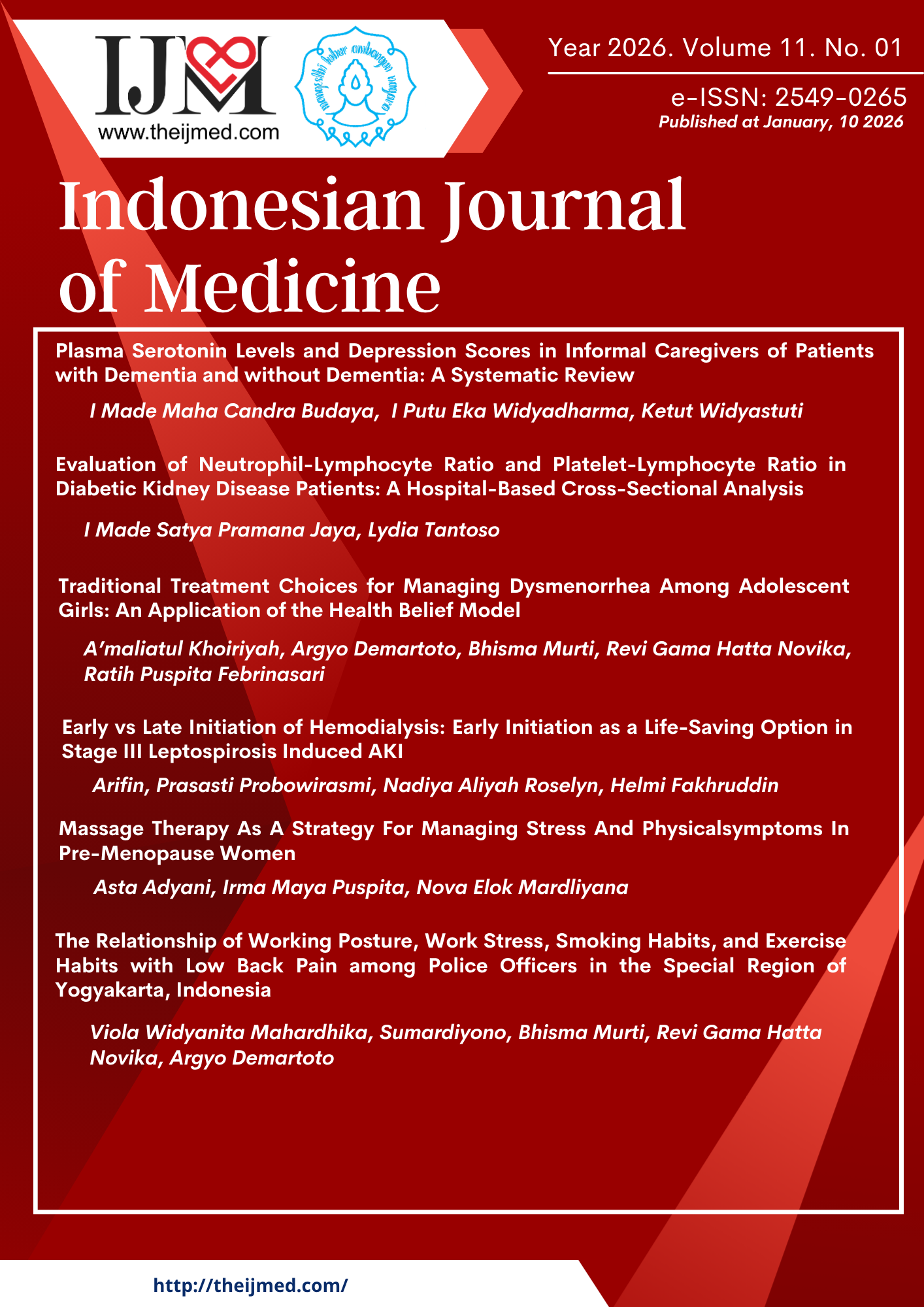
How to Cite
References
Alotiby A (2024). Immunology of stress: a review article. J Clin Med. 13(21): 6394. https://doi.org/10.3390/jcm13216394.
Badawy Y, Spector A, Li Z, Desai R (2024). The risk of depression in the menopausal stages: a systematic review and meta-analysis. J Affect Disord. 357: 126–133. https://doi.org/10.1016/j.jad.2024.04.041.
Dewangan RL, Goswami T (2025). Organizational role stress, quality of work life, organizational citizenship behavior, and psychological well-being among university faculty members. BMC Psychol. 13(1): 538. https://doi.org/10.1186/s40359-025-02883-x.
Döner Şİ, Dağ Tüzmen H, Duran B, Sunar F (2024). The effect of aromatherapy massage with lemon and peppermint essential oil on menopausal symptoms: a double-blinded randomized placebo-controlled clinical trial. Explore (NY). 20(3): 313–318. https://doi.org/10.1016/j.explore.2023.09.001.
Fidecicchi T, Giannini A, Chedraui P, Luisi S, Battipaglia C, Genazzani AR, Genazzani AD, et al. (2024). Neuroendocrine mechanisms of mood disorders during menopause transition: a narrative review and future perspectives. Maturitas. 188: 108087. https://doi.org/10.1016/j.maturitas.2024.108087.
Fruitasari MF (2024). Menopause Symptoms in Premenopausal Women. J Nurs Invent. 5(1). https://doi.org/10.33859/jni.v5i1.507.
Hachul H, Oliveira DS, Bittencourt LRA, Andersen ML, Tufik S (2014). The beneficial effects of massage therapy for insomnia in postmenopausal women. Sleep Sci. 7(2): 114–116. https://doi.org/10.1016/j.slsci.2014.09.005.
Hanus A, Fogarty S (2025). The effects of massage therapy on post-traumatic stress disorder: a case report. Int J Ther Massage Bodyw. 18(3): 42–50. https://doi.org/10.3822/ijtmb.v18i3.979.
Jenabi E, Shobeiri F, Hazavehei SMM, Roshanaei G (2015). Assessment of questionnaire measuring quality of life in menopausal women: a systematic review. Oman Med J. 30(3): 151–156. https://doi.org/10.5001/omj.2015.34.
Kim JH, Yu HJ (2025). Non-pharmacological intervention effects on middle-aged women with menopausal symptoms: a systematic review and meta-analysis. Healthcare (Basel). 13(24): 3206. https://doi.org/10.3390/healthcare13243206.
Lang XL, Huang CC, Cui HY, Zhong HX, Shen MY, Zhao F (2025). From physiology to psychology: an integrative review of menopausal syndrome. World J Psychiatry. 15(11): 108713. https://doi.org/10.5498/wjp.v15.i11.108713.
Listiana E, Anggorowati A, Susilawati D (2022). Massage therapy to relieve menopausal symptoms: a systematic review. Jurnal Kebidanan. 11(1): 9–20. https://doi.org/10.26714/jk.11.1.2022.9-20.
Mardliyana NE, Puspita IM (2022). Terapi komplementer pada pelayanan kebidanan (Complementary Therapies in Midwifery Care). Yogyakarta: Deepublish.
Mehrnoush V, Darsareh F, Roozbeh N, Ziraeie A (2021). Efficacy of the complementary and alternative therapies for the management of psychological symptoms of menopause: a systematic review of randomized controlled trials. J Menopausal Med. 27(3): 115. https://doi.org/10.6118/jmm.21022.
Mosconi L, Berti V, Dyke J, Schelbaum E, Jett S, Loughlin L, Jang G, et al. (2021). Menopause impacts human brain structure, connectivity, energy metabolism, and amyloid-beta deposition. Sci Rep. 11(1): 10867. https://doi.org/10.1038/s41598-021-90084-y.
Ntoumas I, Karatzaferi C, Boubougiatzi F, Manakou N, Aslanidi A, Giannaki CD, Papanikolaou F, et al. (2025a). Massage positively influences daytime brain activity and reduces arousal state in poor sleepers: a randomized controlled trial. BMC Complement Med Ther. 25(1): 290. https://doi.org/10.1186/s12906-025-05022-6.
Putri SE, Susilawati S, Lathifah NS (2024). Hubungan pengetahuan dan sikap dalam menghadapi gejala menopause pada wanita perimenopause di Klinik Wede Ar Rachman (The relationship between knowledge and attitudes toward menopausal symptoms among perimenopausal women at Wede Ar Rachman clinic). Malahayati Nurs J. 6(7): 2788–2801. https://doi.org/10.33024/mnj.v6i7.11920.
Qin S, Xiao Y, Chi Z, Zhu D, Cheng P, Yu T, Li H, et al. (2020). Effectiveness and safety of massage in the treatment of anxiety and depression in patients with cancer. Medicine (Baltimore). 99(39): e22262. https://doi.org/10.1097/md.0000000000022262.
Qu Z, Sun X, Zhang X, Yin J, Zhang X, Zhao H, Zhang H (2025). The effects of sensory stimulation therapy in patients with sleep disorders: a scoping review. Front Neurosci. 19: 1682267. https://doi.org/10.3389/fnins.2025.1682267.
Rozifa AW, Mardliyana NE, Puspita IM (2023). Description of the implementation of complementary therapy in midwifery services in Surabaya, Indonesia. Majalah Obstetri & Ginekologi. 31(2): 75–79. https://doi.org/10.20473/mog.V31I22023.75-79.
Shin H, Park C (2025). Perceived stress shapes symptom and social network dynamics: a network analysis of depression, anxiety, and relation¬ship-specific support and strain. BMC Psychiatry. 25(1): 715. https://doi.org/10.1186/s12888-025-07146-y.
Umamah F, Lestari A (2018). Hubungan pre-menopause dengan kejadian hipertensi pada wanita di RT 11 RW 05 Kelurahan Banjarbendo Sidoarjo. J Health Sci. 9(1). https://doi.org/10.33086/jhs.v9i1.189.